
Klarna applies for U.S. industrial bank license, accelerating financial expansion
Klarna has submitted an industrial bank (ILC) charter application to the U.S. Federal Deposit Insurance Corporation (FDIC) and the Utah Department of Financial Institutions, planning to internalize its banking operations. The company currently relies on partner institutions like WebBank in the U.S. to provide BNPL services, and this move is seen as a key step in deepening its U.S. market presence.
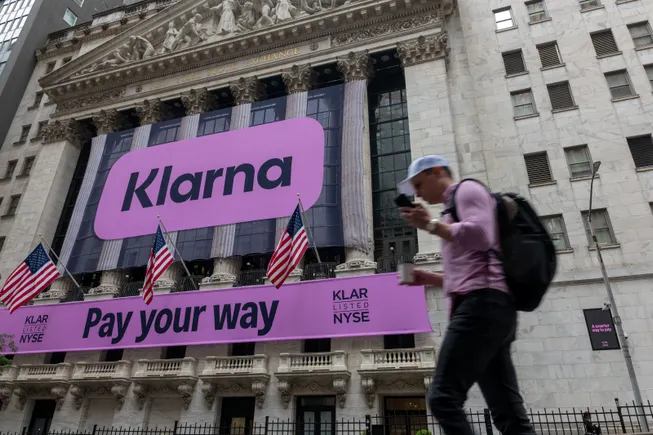
"Buy now, pay later" (BNPL) giant Klarna is betting on offering more financial services to solidify its market position. To this end, the Swedish company submitted a charter application to establish an Industrial Loan Company (ILC) to the U.S. Federal Deposit Insurance Corporation (FDIC) and the Utah Department of Financial Institutions on Monday (July 2).
Klarna has held a banking license and operated banking business in Europe since 2017, but in the U.S. market, its financial services have long relied on partnerships with financial institutions, with WebBank being one of its key partners. A company spokesperson declined to comment on other banking partners or intermediaries.
Now, Klarna is seeking more autonomous control over these operations and taking the opportunity to expand into more financial services. A company press release on Monday noted that this move is expected to inject more competitive vitality into the U.S. market.
"Having our own banking license is a natural next step, providing customers with tools for responsible borrowing to help build financial confidence, while bringing more competition, innovation, and choice to consumers and merchants," said Klarna CEO Sebastian Siemiatkowski in the press release.
Although Klarna is headquartered in Stockholm and registered its initial public offering (IPO) in London last year, its strategic focus is increasingly shifting toward the United States. A company spokesperson said via email that the U.S. is its largest market by revenue, and most of its investors are based in the U.S.
Klarna was founded in 2005 under the name Kreditor and adopted its current name in 2010. After its initial public offering last year, its stock price has fallen by about half, impacted by the overall downturn in the fintech industry.
Trend of internalizing banking operations
Klarna is not the only payment technology company seeking to strengthen financial services through a banking license. Digital payment pioneer PayPal and BNPL competitor Affirm have also submitted ILC charter applications in recent months.
Siemiatkowski has been committed to disrupting the U.S. financial services market from an early stage. Klarna's iconic BNPL service has provided American consumers with an alternative to traditional banking and credit card products.
If the company successfully obtains a U.S. banking license, it says it will bring banking operations in-house, a move expected to reduce reliance on third-party partners to some extent, although the press release still mentions "valuable partner banks."
With the help of existing partners, Klarna has already built a vast consumer base in the U.S. According to press release data, since 2019, Klarna has provided a total of $91.3 billion in credit to millions of U.S. consumers while serving hundreds of thousands of merchants.
According to its website, Klarna has approximately 119 million active consumers globally, serves about 1 million merchants, and operates in 26 countries, including well-known brands such as Sephora, H&M, and Adidas.
If the FDIC-insured banking license is approved, Klarna Bank will operate as a subsidiary of the company, led by Gary Harding. Harding previously served as CEO of Milestone Bank and Prime Alliance Bank.
Political maneuvering clouds banking license
The type of ILC license Klarna is seeking has become a point of political controversy. Some Republican and Democratic lawmakers, backed by the banking industry, argue that ILC charters exempt companies from the definition of "bank" under the Bank Holding Company Act. Lawmakers have expressed concerns that as long as an ILC does not offer demand deposit accounts, it can bypass Federal Reserve oversight.
In January, Senators John Kennedy (R-La.) and Andy Kim (D-N.J.) introduced a bill aimed at closing what they call the "shadow banking loophole." The bill is currently before the Senate Banking Committee.
The Independent Community Bankers of America (ICBA) said in May that excluding the Federal Reserve from ILC oversight "leaves a dangerous gap in safety and soundness supervision and introduces unnecessary systemic risk into the banking system."
Last year, Kim and Senator Elizabeth Warren (D-Mass.) proposed a moratorium on commercial-owned ILC charters until such entities are clearly defined as "banks" under the Bank Holding Company Act.
Despite this, regulatory officials appointed by Trump have signaled greater acceptance of ILCs. FDIC Chairman Travis Hill last year described the ILC charter as one of the few avenues for promoting new bank formation.
Automaker Stellantis received approval to establish an ILC in May, Ford and General Motors received approval in January, and investment firm Edward Jones followed with approval in February.