
OCC Responds to Surge in Charter Applications: A Look at Workload and Resource Allocation
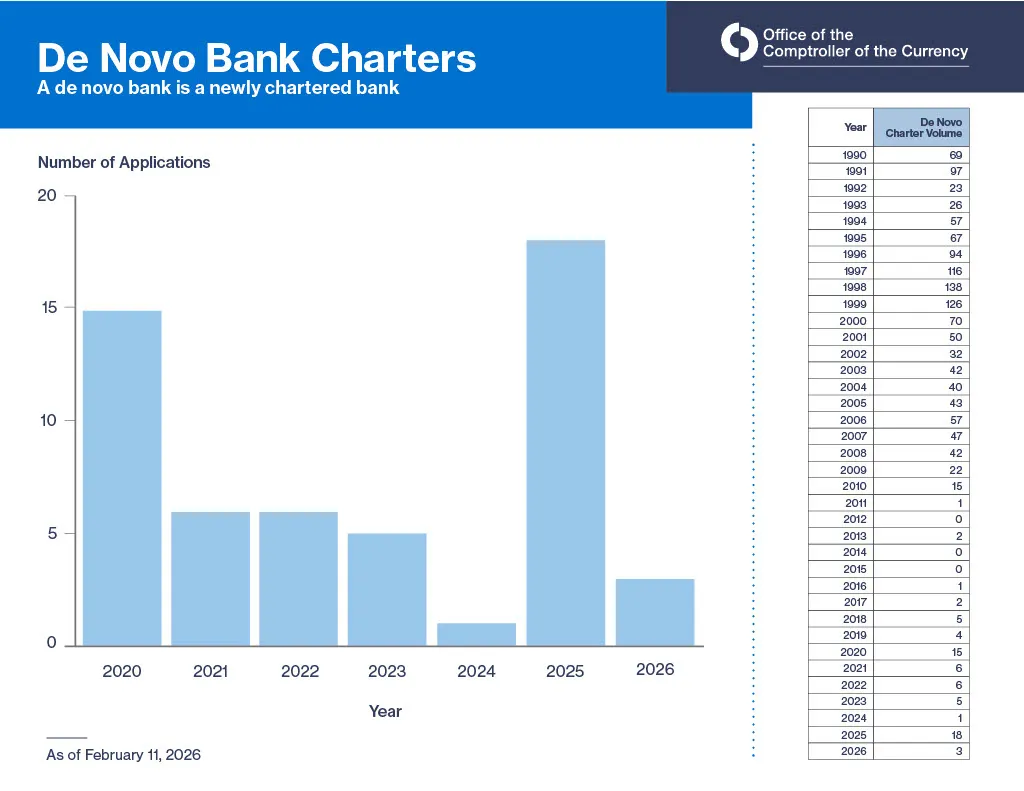
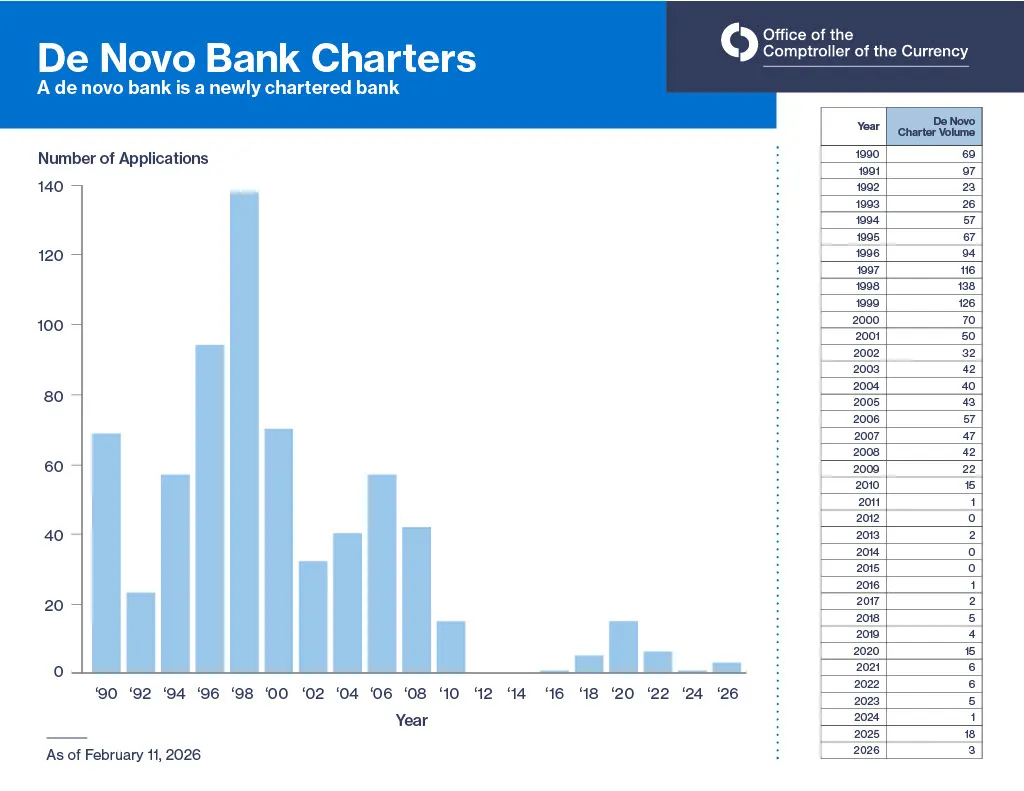
In 2025, the Office of the Comptroller of the Currency (OCC) received 18 bank charter applications, matching the total of the previous four years combined and marking the highest number since 2008. Comptroller Jonathan Gould described this surge as a 'return to normalcy,' but historical data shows that between 1990 and 2008, application volumes were often more than double current levels. To manage the workload, Gould reorganized the chartering department, adjusted the chain of command, and utilized a rotation mechanism to supplement staffing.


Approved by the Office of the Comptroller of the Currency
The number of bank charter applications surged last year, reaching the highest level since 2008. The 18 bank charter applications submitted to the Office of the Comptroller of the Currency (OCC) in 2025 equaled the total number of applications received in the previous four years combined.。
In December of last year, the agency's head, Jonathan Gould, called the surge in applicationsa "return to normalcy."However, from 1990 to 2008, the number of charter applications was at least double that of 2025 in nearly every year, and in two of those years, it peaked at seven times that amount.
Approved by the Office of the Comptroller of the Currency
Earlier this month, Gould said in an interview that he "wouldn't presume to speculate" about whether there is an "appropriate" level of interest. He emphasized: "Generally speaking, in this country, the formation of new banks is a sign of the health of the banking system. Where conditions permit and it is consistent with the law, we should encourage the formation of new banks, because it is a way to ensure that the banking system can continue to serve communities and economies across the United States."
Gould noted that after the 2007-08 financial crisis, the agency's enthusiasm for new bank charters plummeted—a sentimentechoed by Travis Hill of the Federal Deposit Insurance Corporation, another regulator head from the Trump era. Many of the banks that failed during the financial crisis—such as Lehman Brothers, Washington Mutual (acquired by JPMorgan Chase), and Wachovia (acquired by Wells Fargo)—were not newly formed banks but rather had histories spanning over a century. Nevertheless, the sharp decline in the number of newly formed banks reflects a decrease in the banking system's risk tolerance after 2008.
"We see this in many other areas, such as our regulation and supervision," Gould said. "For me, this is just a very important aspect that has a unique impact on the OCC, because we are the only chartering authority at the federal level."
Approved by the Office of the Comptroller of the Currency
Gould served as the agency's chief legal counsel from 2018 to 2021. He wasnominatedas Comptroller of the OCC in February 2025 andconfirmedin July of the same year. Since his return, he has been working to enhance the agency's chartering division.
Ace Up His Sleeve
Six months ago, Gould took over the department then known as the Licensing Group, renamed it the Chartering and Structure Team, and changed the division's chain of command so that it reports directly to him. Gould said it is "critical" to the federal banking system and "in a sense, it is the gatekeeper of the system."
The chartering office is run by Stephen Lybarger, a veteran OCC employee who joined the agency right after graduating from college in 1984. By 2010, he had become a senior deputy in the division, and last year he was promoted to Senior Deputy Comptroller. Many members of his team have also spent years at the OCC.
According toBloomberg Lawa memo seen by the outlet showed that the agency's workforce decreased by 216 people in late winter of last year, including layoffs of probationary employees and voluntary resignations. Gould did not disclose how many employees left the chartering division, but he told Banking Dive that the reduction "prompted us to take a more serious look at how we allocate resources and ensure that we are maximizing the use of our skilled workforce."
However, Gould's ace up his sleeve is a system he established during his previous tenure at the OCC: a mechanism for rotating staff from supervisory roles into the chartering office, ensuring "a true pipeline of talent." Examiners are rotated from supervisory positions to the chartering department for one- to two-year assignments, and the department "benefits from skilled and capable examiners playing roles that are slightly different from their day-to-day roles," allowing them to directly address the growing demand for charters. Gould said that when this mechanism was established, the leaders of the chartering function were aging, and this change created conditions for a "next-generation talent pool."
Given that several of the 18 charter applications in 2025 have alreadyreceived conditional approval, and one of them (Erebor)has already opened as a bank, the chartering division and its pipeline of projects may be operating at full capacity.