
Lancaster County, Pennsylvania Banks Provide 'Meaningful' Financial Services to Amish Community
In Lancaster County, Pennsylvania, several banks are serving the largest Amish community in the United States in unique ways. From investing $1 million to build a fleet of mobile bank vehicles, to using Amish directories for customer identity verification, to designing exclusive loan products for homes without electricity, these practices not only meet the financial needs of the Amish people but also reveal the differentiated survival strategies of community banks amid the wave of digitalization.
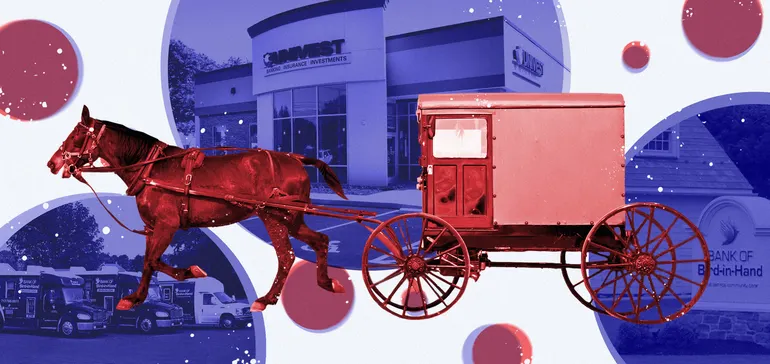
In today's competitive financial services environment, having a robust mobile banking platform that can provide services anytime, anywhere has become a necessity for bank operations. However, Bird-in-Hand Bank, located in Lancaster County, Pennsylvania, has a mobile banking operation that goes beyond digital apps, featuring a fleet of true "banks on wheels," making it one of the innovative examples of financial institutions serving the largest Amish settlement in the United States.
"Any time you have to hitch up a horse and buggy to go somewhere, it's a big production," says Lori Maley, CEO of this community bank in Lancaster County, commenting on the preferred mode of transportation for most Amish people. The Amish generally avoid modern technology such as electricity, cars, and telephones. "We created this opportunity for the Amish so they don't have to drive to our branches. If service points are closer to them, it's more convenient for some, and we've tried to strategically place service points in areas where we have customers and shareholders." Maley says the bank has invested $1 million in four 29-foot mobile banking units.
Bird-in-Hand Bank's first "gelt bus" (Yiddish for "money bus") went into service in 2018. Last October, the bank added two more and plans to add a fourth this month (referring to the month the original article was published). These buses travel to 16 locations in the county Monday through Friday, serving as extensions of the bank's three physical branches. The buses offer ATMs, drive-thru customer service windows, and can open accounts and process transactions in areas where the Amish live and do business.
"As a community bank, we need to go to our customers," says Bill O'Brien, the bank's chief lending officer and one of its founders.
Community Backbone
Bird-in-Hand Bank was established in December 2013, becoming the first new (de novo) bank in the United States after the passage of the Dodd-Frank Act in 2010. This community bank, which started with $17 million in initial capital, reported assets of $532 million at the end of 2020. Maley says the bank has performed well since its inception, even during the COVID-19 pandemic, with strong loan quality.
"Regulatory examiners always ask: 'What's the worst-case scenario?' I think we've somewhat experienced it," she says. "While other banks' loan portfolios may have quality issues, this bank doesn't." O'Brien has been lending in the area for over thirty years, earning him the nickname "gelt chappie" (Yiddish for "money man").

"There are 29 banks in this county, but only a few truly have the products this area needs," he says. "This area will always need a community bank." O'Brien estimates that 65% to 70% of Bird-in-Hand Bank's customers are Amish or Old Order Mennonites—a religious group with similar values. He says serving the Amish is a competitive business. "It's a hardworking market—a market where people pay on time," he says, noting that historically, the Amish are known for frugality, which translates to minimal charge-offs on loans.
Erik Wesner, author of the 2010 book "Success Made Simple: Inside an Amish Business Boom," says this financial approach, combined with the Amish trustee system (which designates community leaders to help families in financial difficulty), makes them ideal borrowers for banks. "The element of community support reinforces the view of the Amish as attractive customers for certain banks," says Wesner, who also runs the website amishamerica.com. "In terms of reliability in repaying loans, the community support element almost acts as a safety net. Even if an individual family's loan has issues, there's a community behind them. The Amish have a culture of mutual aid."
Tom Jordan, market president at regional lender Univest, says his company has five branches in Lancaster County and has never lost money on community lending. O'Brien also says he has never had a loss on Amish loans, though he knows other banks have had a few transactions with charge-offs. "You don't have many losses, so over time, profits are greater," O'Brien says. "I'd rather have a high-quality loan portfolio than potentially take on more risk for a larger spread. I think the portfolio we have is better than almost any other at a community bank level."
Part-Time Genealogists
Banks hoping to do business with the Amish have found unique ways to accommodate the community's special habits, some of which include a lack of photo identification. According to a blog post by Wesner on amishamerica.com, many Amish avoid having their photos taken, with some believing such practices foster individualism and pride, which conflicts with their religious beliefs. This can become an issue for Amish individuals wanting to open bank accounts when bank customer identification processes involve some form of photo ID.
For Univest, a bank with $6 billion in assets, one solution is having bank employees serve as part-time genealogists. In addition to verifying identity through Social Security cards, birth certificates, or IRS forms, Univest's most unique customer identification method may be through the use of Amish directories. The Amish directory lists the names, birth dates, family relationships, church leadership positions, and occupations of members of Amish settlements in a given area. Jordan says these books, available at local Amish bookstores, show Amish family lineages and are updated every three to four years. Jordan oversaw National Penn Bank's consumer and commercial banking operations in Lancaster County before joining Univest in 2016. "Through this book, we can confirm who you are, where you live, who your parents are, and we've received regulatory approval to use these directories to properly identify customers," he says.
Laurent Pelletier, vice president and commercial branch manager at M&T Bank, says the regional lender's four branches in Lancaster County accept letters from Amish bishops to confirm customers' names, addresses, birth dates, and other personal information. "The trend now is younger Amish have state IDs, but older ones don't," says Pelletier, who estimates 60% to 65% of his branch's customers are Amish. "Over the years I've learned that the Amish are no different from (non-Amish)," Pelletier says. "They have the same needs. There are also people outside the Amish community who choose not to use online or mobile banking, so in that sense, there's no difference."
Economic Transformation
When Pelletier first arrived and managed M&T Bank's Intercourse branch for 16 years, he had resisted efforts to push more Amish customers to adopt the bank's digital platforms. "My boss would tell me, 'Everyone needs to have an online account.' The reality is that today my younger Amish customers and business owners use the available technology, which is online and mobile banking," he says. "On the commercial or business banking side, they use certain services we offer to do their banking from their offices."
Wesner says the Amish's increasing adoption of certain technologies represents an economic transformation for the community. "Over the past few decades, the Amish have really undergone a shift toward business, which has somewhat changed their financial and economic situation," he says. "There's certainly more cash flow and liquid assets within the Amish community now than there were twenty or thirty years ago." Wesner says rising land prices have prompted the Amish to increasingly move from farming to business as a way of life.
"In the past, the hallmark or goal of a successful father was to buy each son a farm, which is impossible today," says Benuel Riehl, a 55-year-old Amish resident of Lancaster County who recently sold his deli business. Riehl recalls that in the 1970s, his uncle stopped bidding on a 100-acre farm because the price reached $100,000. "Today, just 50 years later, that farm would be $2.5 million," he says.
Jordan says the shift toward business has led more Amish to use computers and cell phones for their operations. "We still have some very conservative older customers who just want to use the branch, period, doing business with checks, paper, and people, not technology," he says. "It hasn't shifted massively, but certainly more than five years ago, and definitely more than ten years ago." To accommodate the bank's more traditional customers, Univest offers a mail banking service where customers can mail deposits to branches. "We also use courier services to pick up deposits at farms. It's just another way we help them do their banking," he says.
Regulator Curiosity
Jordan says Univest's primary business with its Amish customers includes farm acquisition financing, construction loans, permit and equipment financing, and residential mortgages. "What we do in residential mortgages is unique because their homes don't always have full electrical service," he says. Jordan says Amish households today may use more electricity than in past decades, but still less than the average American household. "These loans can't be sold on the secondary market, so you have to create a product that must comply with all fair lending rules, regulations, and (Consumer Financial Protection Bureau) requirements," he says. "Then you can keep these loans in your portfolio, on your own books, rather than selling them on the secondary market."
Jordan says overall, regulators are willing to work with banks serving the Amish community and have largely accepted their unique methods of serving that community. "I haven't found many people—from regulators to internal auditors to external auditors—who aren't curious about this," he says. "Most of them are curious in a nostalgic way... It's a unique subset of our culture, people who live among us but live very differently than we do. Many of them are more driven by natural curiosity than risk-related curiosity."
O'Brien says obtaining regulatory approval hasn't always been easy. Early on, Bird-in-Hand Bank struggled to comply with Federal Deposit Insurance Corporation (FDIC) guidelines while still trying to match its products—with some compromises—to the needs of the Amish. O'Brien says that while the FDIC worked with the bank and recognized the area's need for the specialized community banking services Bird-in-Hand Bank provides, regulators were slow to approve flood insurance provided by mutual aid associations. The Amish do not purchase commercial insurance; instead, they contribute to their internal self-insurance network, known as "Amish Aid."
While the Office of the Comptroller of the Currency (OCC) and the Farm Credit Administration accept Amish Aid, the FDIC said in 2019 it would handle cases on an individual basis. "We've reached the point where this is hurting some of them," O'Brien says. "We've scheduled meetings with the FDIC. I think they want to work with us, but it's taken a long time. It's cost some of our customers money, cost us time, and put us at some reputational risk."
Expanding Branches
With a customer base that relies on face-to-face banking, banks in Lancaster County must weigh the economics of building permanent branches against bringing services to customers. An M&T Bank spokesperson says the bank has no plans to close or add branches in Lancaster County, while Maley says Bird-in-Hand Bank has identified several strategic locations where it would consider adding a physical presence.
"With all the market turmoil and other banks closing branches, we may have the opportunity to look at several locations in existing buildings that are crucial to us without building new branches," she says. Jordan says Univest has considered adding a mobile banking operation similar to Bird-in-Hand Bank's to expand its services in the community, but for now, it relies on the success of its courier service. "There are some security concerns that come with it," he says. "We have to make sure we protect our shareholders, depositors, and employees."
Jordan says expanding Univest's branch network in Lancaster County isn't economically feasible at this time. "They want branches, but they won't leave a lot of deposits at the branch," he says. "And from the bank's perspective, that's our business. We make money by lending those deposits to others who need them."
Face-to-Face Service
At a time when the smallest banks in the United States face immense pressure to invest more capital in digital products to meet customer expectations and compete with the multi-billion-dollar budgets of Wall Street banks, they often rely on their deep understanding of the communities they serve and their emphasis on customer relationships as advantages that set them apart. For banks serving Amish customers in Lancaster County, "relationship banking" is more than just a buzzword—it's their lifeline. It helps them serve a traditionalist group that doesn't demand the digital products most Americans expect from their financial service providers.
"Relationship banking—it's a word that gets thrown around a lot," Jordan says. "It's actually sitting at the kitchen table, talking with two or three generations about farm transitions, building homes, or passing a business to the second or third generation—whatever it is... We had a gentleman retire this year who had been serving his third-generation family. You don't see that much anymore." Jordan says serving the Amish isn't for every bank, and the work isn't for every banker. "It's a limited customer pool. There isn't enough business for everyone to do it, and frankly, for some big banks, it's not worth it," he says. "They don't have enough density of opportunity to create unique policies, procedures, products, or conveniences for that segment."
Bankers accustomed to communicating with customers via email or phone may not be suited for the significant amount of face-to-face time the role requires. O'Brien says, "As bankers, we have to be mobile... You have to be willing to go see them when necessary." He adds that on many farm visits, business discussions take place at outdoor picnic tables. "There are a lot of unique things you have to do that not every banker wants to do. But those of us who do it, love it," Jordan says. "You work with one generation, then the next—there are benefits for bankers who choose to work with this community. They have relationship commitment, which is rare these days."
"For them, it's a relationship banking that truly feels good and makes a difference," he says.