
U.S. banks prepare for stricter sanctions against Russia
Global financial institutions are preparing for the economic impact of Western sanctions on Russia. The United States imposed sanctions after the 2014 Crimea crisis, and now, in response to Russia's further actions in Ukraine, the U.S. and its allies have escalated sanctions again, but Russia has established protective measures and may use cryptocurrencies to circumvent them.
Global financial institutions are bracing for the economic shockwaves triggered by Western sanctions against Russia. Banks play a key role in implementing such sanctions, overseeing and controlling funds flowing into Russia through bank transfers, but in doing so, they also expose themselves to consequences that will have ripple effects across the world economy.
The United States imposed sanctions on Russia in 2014 after the Crimea crisis, when Russia invaded and annexed the Black Sea peninsula from Ukraine.The Atlantic Council estimatesthat these sanctions reduced Russia's economic growth by about $50 billion annually (or a total of $350 billion between 2014 and 2020).
Now, the United States and other Western powers are again imposing sanctions on Russia over its aggression against Ukraine. But in the years since the Crimea invasion, Russia has developed new safeguards to protect its economy from Western sanctions and has access to a broader range of cryptocurrency technologies that could help the country circumvent them.
Russian President Vladimir Putin formally recognized the independence of two separatist regions in eastern Ukraine's Donbas—the Donetsk People's Republic and the Luhansk People's Republic—in a speech on Monday evening and sent troops into the territory, ostensibly for peacekeeping purposes. Both republics have claimed independence from Ukraine since 2014.
"The Minsk agreements no longer exist," Putin said on Tuesday, referring to the peace deals brokered with the help of Western powers in 2014 and 2015 aimed at bringing peace to eastern Ukraine without recognizing the separatist regions.
In response to Putin's announcement, the Biden administration, throughan executive order on Monday, imposed strict restrictions on Americans doing business in Donetsk and Luhansk. Any new investment or exports of U.S. goods to these regions are prohibited.
Then on Tuesday,the U.S. Treasury imposed sanctions on two Russian state-owned banks—Vnesheconombank (VEB) and Promsvyazbank (PSB)—and their 42 subsidiaries. The Treasury said PSB acts as Russia's military bank, overseeing nearly 70% of the country's defense contracts and providing personal financial services to Russian military personnel.
The United States also imposed sanctions on Russian oligarchs close to the Kremlin, including Alexander Bortnikov and his son Denis Bortnikov, Sergei Kiriyenko and his son Vladimir Kiriyenko, and PSB Chairman Pyotr Fradkov,according to CBS News. Additionally, the Biden administration sanctioned Russia's sovereign debt to limit the country's ability to raise funds.
Sanctions from abroad
Still, the United States retained significant leverage after announcing the first round of sanctions, hoping to use the threat of future sanctions to deter further Russian aggression in Ukraine.
"We continue to monitor Russia's actions, and if it further invades Ukraine, the United States will swiftly impose broad economic sanctions that will have severe and lasting effects on the Russian economy," Treasury Secretary Janet Yellen said.
Other Western countries have responded accordingly. The United Kingdom imposed sanctions on multiple Russian officials and imposed asset freezes on five banks: PSB, Bank Rossiya, IS Bank, the Black Sea Development and Reconstruction Bank, and Genbank,according to The Wall Street Journal. Rossiya and Genbank had previously been sanctioned by the United States.
The European Union chose to sanction Bank Rossiya, PSB, and VEB. The EU's sanctions also include voting to recognize all members of the Russian lower house of parliament who voted to recognize Donetsk and Luhansk,Reuters reported. German Chancellor Olaf Scholz has suspended certification of the controversial Nord Stream 2 pipeline, owned by Russian state-owned energy company Gazprom, at least for now,CBS reported。
What about SWIFT?
Western powers still have several levers to pressure Russia. For example, the United States has not yet excluded Russia from SWIFT, the international payment system. Removing Russia from SWIFT would harm the country's ability to profit from oil and gas exports, which account for 40% of its revenue,according to the Financial Times。
The United States is avoiding this option because cutting Russia off from SWIFT would cause a costly economic shock to U.S. financial institutions,Protocol reported. In the long term, such actions could prompt Russia and China to build alternative payment systems or further promote the use of blockchain technology to route international payments, thereby reducing the world's dependence on the dollar.
Cryptocurrency could play a role in Russia's efforts to circumvent Western sanctions,The New York Times reported. While Western governments block Russian bank transfers, cryptocurrency provides Russia with another channel to raise capital. The outlet noted that Iran and North Korea have used cryptocurrency to evade Western sanctions.
As tensions escalated recently, Russia accelerated the development of its central bank digital currency (CBDC), which could allow the country to raise liquidity even if excluded from SWIFT,according to Blockworks。
Exposure and contagion
Since the annexation of Crimea in 2014, U.S. financial institutions have limited business dealings with Russia. This first wave of sanctions may have a greater impact on European financial institutions with larger exposure than on their U.S. counterparts.
U.S. banks had claims on Russia of $14.7 billion in 2021,while European banks' exposurewas $30 billion,according to Reuters. Austria's Raiffeisen Bank International is preparing "crisis plans," the news agency reported. The UK's HSBC, meanwhile, warned of some kind of turbulence in global markets.
"There is clearly a possibility of contagion or some second-order effects, but that will depend on the severity of the conflict and, if there is a conflict, the severity of retaliation," CEO Noel Quinnsaid in an interview with Reuters。
One of the biggest threats to Western banks and other financial institutions is the possibility of retaliation from Russia in the form of cyberattacks. There is precedent for such actions, given that Iranian hackers launched cyberattacks on U.S. banking systems in 2012 and 2013 after the West imposed sanctions on Iran over its nuclear program,CNN reported. Ukrainian institutions have reported numerous cyberattacks from the Russian military,including distributed denial-of-service (DDoS) attacks on banks and government websites, according to the BBC。
U.S. officials met with bank executives, including JPMorgan and Citi, to discuss the growing threat of Russian cyberattacks, according to CNN. "Naming just a few oligarchs and a couple of second- and third-tier banks—if you're Russia, you'd really feel like you got away with it," Jason Hungerford, a sanctions-focused partner at Mayer Brown,told the Financial Times。
Harsher sanctions to come
However, sanctions did not stop Russia's objectives. Russian troops launched a full-scale invasion of Ukraine on Thursday, after Putin announced a "special military operation" in the country. The invasion is the largest attack by one sovereign state on another since World War II,Reuters reported. Fighting broke out across much of Ukraine's eastern border, and explosions and gunfire were reported in the capital, Kyiv.
Ukrainian President Volodymyr Zelensky has declared martial law and said his government will provide weapons to any Ukrainian who wishes to join the reserve army. As fighting continues, Western powers are preparing to impose harsher sanctions to cripple Russia's economy.
The banks targeted by the United States on Tuesday account for only 5% of total Russian bank assets,according to the Financial Times. If the United States targets larger, more systemically important banks—such as Sberbank (accounting for 32.6% of Russian bank assets) or VTB (16.4%)—that would pose a more serious threat to Russia.
Such announcements may be forthcoming, given thatReuters reported on Tuesdaythat an unnamed senior U.S. administration official explicitly told reporters that the United States would impose sanctions on Sberbank and VTB if Russia invaded Ukraine.
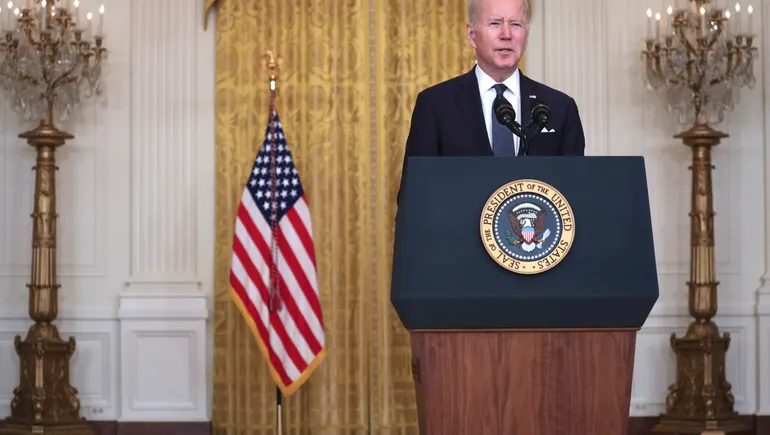
U.S. President Joe Biden is scheduled to speak on Thursday about Russia's latest offensive and announce further economic punitive measures, shifting from a preventive approach to a punitive one. In addition to sanctions on more Russian banks and other financial institutions, such punishments could include directly sanctioning Putin and other senior Kremlin officials and focusing on blocking Russia's access to certain technologies.
The United States aims to act in lockstep with allies, with the EU and the UK also preparing to announce harsher sanctions. "Our mission is clear: diplomatically, politically, economically, and ultimately militarily, this hideous and barbaric venture of Vladimir Putin must end in failure," UK Prime Minister Boris Johnsonsaid on Twitter。
European Commission President Ursula von der Leyen said the EU will impose new sanctions that "will weaken Russia's economic base and its capacity to modernize" and will "freeze Russian assets in the EU and stop Russian banks from accessing European financial markets,"according to the Associated Press. "We want to cut off Russia's industry from access to the critical technologies it needs to build the future today," she added.
In contrast, China did not condemn Russia's attack and approved wheat imports from Russia, a move that somewhat undermines the economic impact of Western sanctions while drawing Moscow and Beijing closer. China has called for a diplomatic resolution to the crisis, but it is the only major government that has not condemned Russia's recent actions,according to The Washington Post。
Since 2014, Russia has restructured its economy to better protect itself from economic punishment. It has accumulated substantial currency reserves, cut government budgets, and reduced its dependence on Western imports,The New York Times reported。